Who is Maslow Anyway?
- guidinglights9
- May 31, 2025
- 4 min read

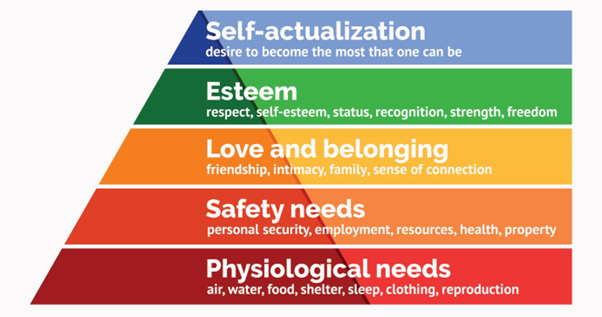

Lots of you will have heard of Maslow and his Hierarchy of needs, or you will have seen 'his' triangle of needs in some dusty old textbook, but who is he and why is he relevant today?
Maslow facts
Maslow’s hierarchy of needs represents part of an important shift in psychology in 1943. Rather than focusing on abnormal behaviour and development, Maslow's humanistic psychology was focused on the development of healthy individuals. Maslow was more interested in learning about what makes people happy and the things they do to achieve that.
It was inspired by the Siksika Nation (Blackfoot) way of life. Maslow spent six weeks living at Siksika in the summer of 1938. It is important to note their contribution and to acknowledge the indigenous roots of his ideas
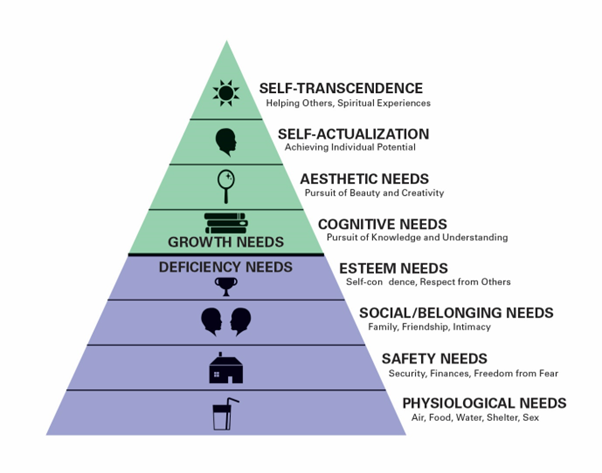
Shortly before his death in 1970, Maslow added three additional levels to his earlier model. Cognitive needs (for knowledge, reason and meaning) and aesthetic needs (for beauty and creativity, e.g., in music and art) now came before self-actualisation, while self-transcendence came at the very top, as the pinnacle above even self-actualisation. While self-actualisation was seen to be the achievement of individual potential, self-transcendence focused on helping others to self-actualise and sensing a spiritual connection.
Businesses recognised it could be useful to increase productivity, so it is often used in business and introduced during management training. Because of when it was written and how it has been used by businesses, it has an individualistic, capitalist bias. Many of the higher-level needs in the hierarchy focus on the self (achievement, self-esteem, personal growth), which cannot necessarily be globalised and easily transferred to Eastern cultures, for instance, that place greater emphasis on community and contribution. It is also not clear whether needs may differ according to gender or socioeconomic background.
Why is Maslow important?
Maslow influenced the work of Carl Rogers. Both men believed that human beings need certain conditions to be in place before they can reach their full potential and have fulfilled life. Carl Rogers used the term self-actualisation as part of his person-centred approach. Rogers believed that as clients overcome barriers, they move towards becoming a more fully functioning person by means of the actualising tendency, spurring us on towards self-actualisation.
Maslow’s ideas are useful in counselling because if a client’s needs are not met, then this can affect the counselling process and their ability to engage. It can help us to understand a client’s story. If there is a failure to have our needs met it may lead to issues with our mental health, for example individuals who do not feel loved, or a sense of belonging may experience depression or anxiety
We might develop defence mechanisms to help us cope with an unmet need, but these can also lead to stress reactions like withdrawal and depression
When safety needs are not met, trauma can sometimes occur. Safety worrying is a major cause of anxiety, phobia, depression, and PTSD

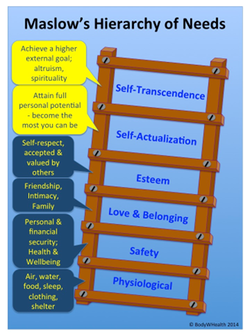



Maslow did not come up with the pyramid! I had no idea until I looked at this recently so I started looking at different ways to represent needs.
What about a ladder? Multiple rungs being used at once by the feet and hands occupied by the feet and hands. Other rungs may be leaned on as well. A ladder does a better job of conveying Maslow’s idea that people can move up and down the hierarchy.
The next diagram with the hierarchy represented by Jenga may be useful as it shows what might happen if certain needs are not met and represents the idea of firm foundations
credit: University of Technology: Sydney
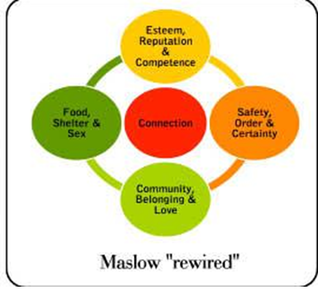
In ”Social Networks: What Maslow Misses", Pamela Rutledge states that “none of his needs—starting with basic survival on up—are possible without social connection and collaboration. Connection is a prerequisite for survival, physically and emotionally. Needs are not in a hierarchy. Life is messier than that. Needs are, like most other things in nature, an interactive, dynamic system, but they are anchored in our ability to make social. The third diagram, Maslow Rewired is by Steve Denning based on Rutledge’s ideas
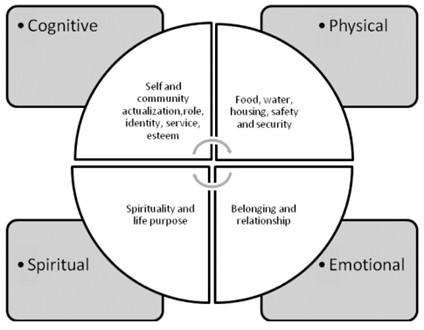
In the last diagram Blackstock (2011) represents Seneca First Nation member and psychologist Terry Cross’ ideas in this circular model. Blackfoot scholar Billy Wadsworth also talked to Cindy Blackstock in 2011. He stated that Maslow did not “fully situate the individual within the context of community.” If he had done so, and also more deeply integrated the Blackfoot perspective, “the model would be centred on multi-generational community actualisation versus on individual actualisation and transcendence.” Maslow later said ‘self-actualization is not enough. Personal salvation and what is good for the person alone cannot be really understood in isolation. The good of other people must be invoked as well as the good for oneself.’
Questions
How do the diagrams differ from one another?
Why do you think people have adapted his ideas?
Which do you think is the most useful/ best representation?
I have been left after writing this blog with more understanding of Maslow's Hierarchy and have found myself finding out more about the Siksika Nation. Hope you have found it interesting too.
Further Reading/ Exploration
Kaufman, SB (2020) Transcend: The New Science of Self-Actualization. Tarcher Perigee.
https://www.psychologytoday.com/gb/blog/positively-media/201111/social-networks-what-maslow-misses-0 Rutledge
https://youtu.be/CF2c1q_OvdE An introduction to Maslow's Hierarchy of needs - Abraham Maslow by Counselling Tutor
https://youtu.be/aRzejkbeH5s Rethinking Maslow's Hierarchy of Needs
https://gatherfor.medium.com/maslow-got-it-wrong-ae45d6217a8c Could the Blackfoot Wisdom that Inspired Maslow Guide Us Now? By Teju Ravilochan (contributing editors: Vidya Ravilochan and Colette Kessler)


Comments